

The Protest Is Over. Now What?
We are being managed.
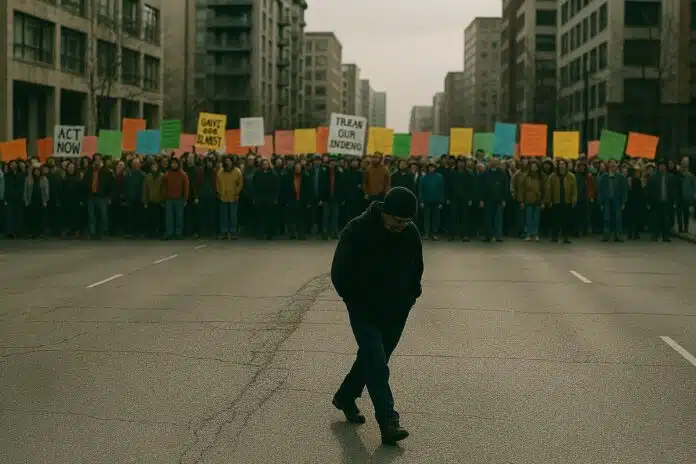
Another weekend, another “No Kings” protest. Another chance for people to gather in designated areas at designated times, hold up clever signs, chant for a few hours, and then go home.
And nothing changes.
Caitlin Johnstone said it plainly this week: “The problem isn’t ‘kings’, the problem is US presidents.” She’s writing about the United States, but we know what she’s talking about. Up here, we watch the same script play out. We borrow their movements, their slogans, their framing. And we end up in the same place: nowhere.
We need to stop pretending this is working.
The Comfort of the Crowd
Look at what these protests actually are.
They are coordinated with the police. They take place in pre-approved zones. They make no demands that would require a change in how power actually operates. They are designed—deliberately designed—to be as inoffensive as possible.
You show up. You feel the energy of being with other people who see the same insanity you do. That feeling is real. But what happens after?
You go home. The politicians take note of the crowd size, offer a few sympathetic words, and then go right back to approving pipelines, arming foreign militaries, and signing over public assets to private corporations.
This isn’t resistance. It’s a pressure-release valve. A controlled burn to keep the forest from actually catching fire.
Protest is Over: So What Are We Actually Protesting?
If you’re marching against one man, you’ve already lost.
That man is a symptom. The disease is the system itself. The capitalist system that requires exploitation to function. The imperial system that Canada willingly participates in. The political arrangement that puts billionaires above neighborhoods and profit above people.
Johnstone writes: “Donald Trump is a US president who is doing US president things. US presidents consistently murder people with unforgivable acts of mass military violence, mistreat immigrants and marginalized communities, and promote tyranny for the benefit of corrupting special interests.”
Canadian prime ministers do the same things, just with softer branding. They send arms. They sign trade deals that strip away sovereignty. They manage the empire’s northern territory while pretending to be something different.
So when your protest is aimed at putting a different face on that same machinery, you’re not fixing anything. You’re just changing the packaging.
Revolutionary Socialism: The Alternative We Keep Ignoring
There is an alternative. It has a name. And it’s not taught in schools, not debated in Parliament, not covered on the evening news.
Revolutionary socialism.
Not the watered-down version. Not social democracy with a smile. Revolutionary socialism means replacing capitalism—not regulating it, not humanizing it, not asking it to be kinder.
It means workers owning the means of production. It means production for human need, not private profit. It means real democracy in the workplace and the community, not just a vote every four years between two brands of the same ruling class.
Revolutionary socialism understands that you cannot reform a system whose fundamental purpose is exploitation. You can only replace it.
And it understands that replacement will not come from politely asking those in power to give up their power. It will come from building enough organized strength to take it.

So What Actually Works?
We have to stop asking what feels good and start asking what threatens the machinery.

Here’s what that looks like. Things that have worked before. Things that can work again. Things that revolutionary movements have always understood.
1. General Strikes
Shut down the economy where it hurts. Not a symbolic one-day walkout. Sustained refusal to work. Labour is the only real leverage working people have. When workers stop moving the goods, running the schools, and collecting the garbage, the people in charge start paying attention. This is how revolutions begin.
2. Mass Rent Strikes
Withhold the money that flows upward. Organize building by building, neighborhood by neighborhood. When landlords stop getting paid, they start screaming at the banks. The banks start screaming at the politicians. It creates a pressure that no press release can match. In Canada, with housing costs strangulating entire generations, this is not abstract theory. It’s a weapon we already hold.
3. Targeted Economic Blockades
Not scattered, symbolic acts. Identify the choke points. Ports. Rail yards. Distribution hubs that keep the system running. Disrupt them nonviolently but effectively. When the flow of capital is interrupted, the system responds very differently than it does to a permitted march.
4. Sustained Civil Disobedience with a Clear Demand
The civil rights movement didn’t succeed because of the March on Washington. It succeeded because of years of sit-ins, freedom rides, and jail-ins that refused to stop. The demand was simple and absolute. Revolutionary socialism makes similarly absolute demands: no more capitalism. No more empire. No more rule by the few.
5. Parallel Institutions
Build what we need outside of their control. Mutual aid networks. Community defense. Independent food and medical systems. When you stop needing the system to survive, you stop having to ask it for permission to live. This is what organizers call “dual power”—creating the structures of the new world inside the shell of the old.
The Lies We Tell Ourselves
We tell ourselves that we can’t do these things because they’re too hard, too risky, too disruptive.
But here’s the question: what’s the cost of not doing them?
The war in Iran is the most obviously evil American war in generations, as Johnstone notes. And what is Canada’s response? Silence. Complicity. A few permitted protests that don’t disrupt a single plane taking off, a single bomb being loaded—many of which pass through Canadian airspace.
If we’re not willing to be disruptive, we’re not willing to be effective. And if we’re not willing to be effective, we’re just volunteering as set dressing for a system we claim to oppose.
What This Isn’t
This isn’t a call for violence. Most of the most effective disruption in history has been nonviolent. But nonviolent doesn’t mean nice. It doesn’t mean polite. It doesn’t mean asking nicely for the fifth decade in a row.
It means applying pressure at the points where the system is weak.
It means refusing to participate.
It means making the cost of continuing business as usual higher than the cost of giving in.
Where We Are Now
Right now, the people with the power are not scared of you. They are not scared of your signs. They are not scared of your chants. They are not scared of your vote, which they have learned to circumvent or ignore.
They should be scared of you.
They should be scared of what happens when you stop asking and start demanding. When you stop marching in circles and start blocking their supply lines. When you stop handing them your labour for a wage that disappears into rent and debt, and you simply… stop.
Johnstone ends with a truth that should land like a weight: “Americans of conscience should be feeling deeply embarrassed right now.”
Canadians of conscience should be feeling the same way.
Because we know better. We’ve seen this movie before. We know what actually made the powerful sweat. And we’re still choosing the version of activism that lets them sleep easy.
That choice is ours. And we don’t get to pretend we didn’t make it.
_______________
❖
Sources & Further Reading
Caitlin Johnstone, “The Problem Isn’t ‘Kings’, The Problem Is US Presidents”
The essay that sparked this conversation, laying out clearly why our current protests are designed to fail by those who benefit from the status quo.
“What Is Revolutionary Socialism?” from Socialist Alternative (Canada)
A clear, accessible primer on the revolutionary socialist tradition, its principles, and how it differs from mainstream social democracy—written from a Canadian context.
“Lessons from the 2018–2019 Oakland Teachers’ Strike”
A case study in how a sustained, localized labour action with community support achieved what years of lobbying could not, winning concrete gains and building lasting power.
“How the Civil Rights Movement Really Won” from The Atlantic
An examination of how strategic, disruptive direct action—not just marches and speeches—was essential to breaking the back of Jim Crow.
_______________
❖