


📍 You are reading Part 4 of 5: The Illusion of Stability
Part of the series: “When Democracy Fails — Rethinking Canada’s Future”
“Each part builds on the last. Skipping ahead will cost you the argument.”
Navigation:
[« Part 1] | [Part 2] [Part 3] | [Part 4 »] | [Part 5] [Pillar Page]
Reading time: approx. 8 minutes
Part 4 — The Illusion of Stability: Why Incremental Reform Is a Trap for the Working Class
Series: When Democracy Fails — Rethinking Canada’s Future
There’s a belief that sits underneath almost every polite political conversation in Canada.
It sounds reasonable. Measured. Responsible.
“The system isn’t perfect—but it can be fixed.”
That sentence does more work for the ruling class than any lobbyist ever could.
It keeps you engaged in a game you cannot win.
It keeps debate inside safe boundaries that never threaten power.
It keeps the structure itself off the table.
And most importantly—
It keeps your expectations low enough that failure feels normal,
and your anger contained long enough for the next election to reset the clock.
Reform Is Always Just Around the Corner. It Never Arrives.
Every few years, the same promises come back like seasonal allergies:
We’ll strengthen accountability.
We’ll empower Parliament.
We’ll loosen party control.
This time will be different.
It’s never different.
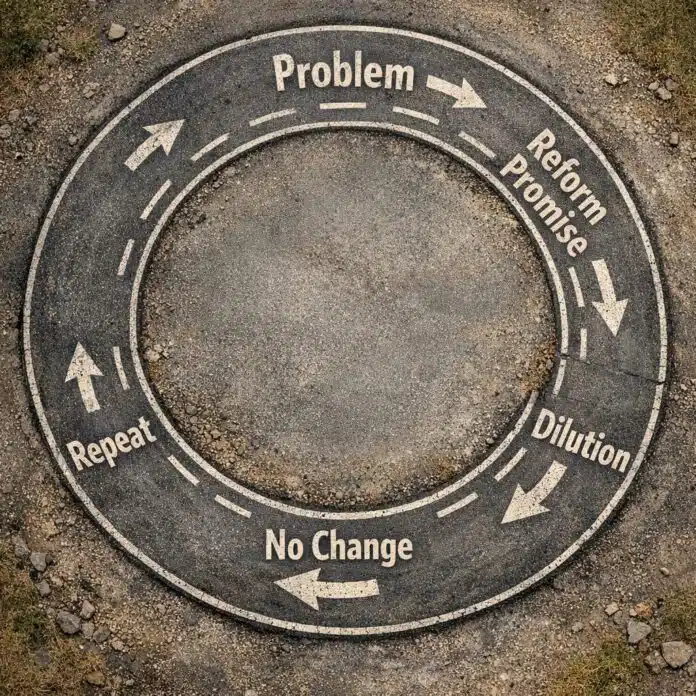
Reforms get proposed. Studied. Diluted.
What survives is almost always procedural:
Small changes. Technical adjustments. Carefully limited scope.
Nothing that shifts where power actually sits.
Nothing that threatens the PMO’s command bunker.
Nothing that gives your MP a real vote or your landlord a real consequence.
Reform isn’t blocked by accident. It’s blocked by design.
The System Filters Out Threats Like an Immune System
Any system that concentrates power must protect that concentration.
It does this by controlling how change happens—and what kind of change is even allowed.
-
-
-
Proposals that don’t threaten the core?
→ They move forward slowly, providing the appearance of responsiveness. -
Proposals that do threaten the core?
→ They stall. They get rewritten. They disappear into committees.
Not dramatically. Quietly. With a press release thanking everyone for their input.
-
-
This isn’t conspiracy. It’s structural immune response.
The system rejects anything that would fundamentally alter it.
And it does this automatically, regardless of which party holds the title.

The People With Power Will Never Vote to Give It Up
This is the part liberal reformers refuse to say aloud—because it sounds cynical, and cynicism is impolite.
But it’s also obvious.
The people who have the most influence inside the system…
Got that influence from the system.
They rose within it. Adapted to it. Succeeded because of it.
Why would they dismantle the structure that put them there?
Why would they weaken the tools they rely on?
Why would they open space that could reduce their control?
They won’t.
Not in any meaningful way.
Not voluntarily.
Not through “good faith” negotiations.
You don’t ask the landlord to voluntarily reduce rent.
You don’t ask the CEO to voluntarily raise wages.
And you don’t ask the political class to voluntarily give up power.
Incentives matter more than intentions.
And every incentive in Canada’s political system rewards obedience, not reform.
Even Incremental Reform Becomes Performance—Not Change
Watch the pattern closely, and you’ll see it everywhere:
Announcements. Committees. Reports.
Language about modernization and renewal and building back better.
It creates movement—but not change.
It signals responsiveness—without shifting power.
The system acknowledges the problem, studies the problem, hires consultants for the problem—
and then does nothing structural about the problem.
That’s not reform.
That’s containment.
A pressure release valve designed to drain your energy until the next election cycle.

We’re Trained to Accept Gradualism—While Rome Burns
In Canada, there’s a deep cultural instinct toward moderation.
Don’t overreact. Don’t push too hard. Don’t be like the Americans. Fix things step by step.
That instinct works in systems that are basically sound.
It’s fatal in systems designed to resist change.
Because gradual pressure gets absorbed.
Adjusted to. Normalized. Neutralized.
Before it ever reaches the core.
The ruling class loves gradualism.
It’s the slowest possible path to nowhere.
It burns your energy, your hope, and your time—
while the wealth gap widens, housing becomes a fantasy, and your MP stays a prop.
Gradualism is not patience. It’s pacification.
Stability Is Not Democracy—It’s Often the Opposite
This is the argument that shuts everything down:
“We’re stable. Look at other countries. At least we’re not collapsing.”
Yes. Canada is stable.
But stability can come from different sources.
-
-
- It can come from balance and accountability—a system that bends because it must.
- Or it can come from control—a system that limits disruption, manages outcomes, and narrows the space where real change can happen.
-
We have the second. And as I wrote in Class Conflict vs Class War in Canada, that silence isn’t peace. It’s [the quiet before the break].
Those two forms of stability look similar on the surface.
But they are not the same.
One is democracy.
The other is management.
Canada has the second. And the first is a museum piece we visit on election day.

Coyne Shows the Resistance. We’re Naming the Wall.
Andrew Coyne documents how reform after reform has stalled.
How proposals disappear. How structures persist.
How the incentives align against change.
This is the logical conclusion of that pattern:
The system doesn’t just fail to fix itself.
It actively prevents meaningful repair.
Not because individual politicians are evil.
Because the structure rewards those who maintain it and punishes those who challenge it.
And that structure doesn’t care about your petitions, your letters, or your “concern.”
This Is Why Frustration Builds—Then Fades. On Repeat.
You’ve lived this cycle a dozen times:
-
-
- Something breaks (housing, health, wages).
- People get angry.
- Promises are made.
- A small reform is announced.
- Nothing fundamental changes.
- Attention moves on.
- The system resets.
-
That rhythm isn’t accidental.
It’s how the structure manages dissent.
For where change actually starts, we have to look outside the system entirely—at organizing, not voting.
Give them just enough to hope.
Never enough to win.
Keep the machine running.
Wait for the outrage to tire itself out.
It’s not a bug. It’s the maintenance schedule.
We Keep Asking the Wrong Question—And That’s the Point
“How do we fix the system?”
That question assumes the system is open to being fixed.
It assumes the structure has a self-correcting mechanism that just needs a little nudge.
But what if it doesn’t?
What if the system is designed to absorb reform without changing its core behaviour?
Then the question itself becomes part of the problem.
Because it keeps your focus on improvement—
instead of on limits.
And the limit is this:
You cannot reform a system whose entire purpose is to protect the power of the few against the needs of the many.
Reform Works When Power Is Distributed. Ours Isn’t.
Reform works when:
-
-
- Power is distributed across institutions.
- Those institutions are responsive to pressure.
- Accountability mechanisms actually function.
-
When power is centralized—
When incentives protect the status quo—
When accountability is a performance—
Reform hits a ceiling.
And that ceiling doesn’t move.
It’s not concrete. It’s reinforced steel.
It’s the PMO. It’s party discipline. It’s a political class that owes its career to keeping you out.
You don’t negotiate with that ceiling.
You remove it.
So What Actually Changes Things?
History doesn’t offer many examples of deeply embedded systems transforming themselves from within.
Not when the existing structure benefits those in control.
Not when pressure is managed instead of released.
Not when change threatens the foundation.
Change doesn’t come from inside the system.
It comes when the system can no longer contain the demand for something different.
That demand—a democratic mass movement—is the only force that has ever won structural change.
That demand isn’t built in committee rooms.
It’s built on picket lines, in tenant organizing, in mutual aid networks, in strikes that refuse to beg.
Reform asks permission. Revolution takes what’s needed.
That’s the Part Canada Avoids—Because It’s Terrifying
We stay inside the language of reform—
Adjustment. Improvement. Modernization. Bipartisan solutions.
Because anything beyond that feels too big.
Too uncertain.
Too disruptive.
But staying inside that language has a cost.
A deadly one.
It keeps us locked in a cycle where:
-
-
- Problems are recognized.
- Solutions are proposed.
- Nothing fundamental changes.
- And the rich get richer while we argue about process.
-
That’s not pragmatism. That’s paralysis dressed up as maturity.
Where This Leaves Us (And What Comes Next)
Part 1: The system is a crime scene.
Part 2: The PMO is the weapon.
Part 3: Parliament is the hostage.
Part 4: Reform is the trap.
At this point, the pattern is complete.
Not as an opinion.
As a structure that repeats—until something breaks.
The only question left is whether we wait for the system to collapse under its own contradictions,
or whether we organize to replace it with something that actually serves the many, not the few.
Next: Beyond Reform
In Part 5, we stop circling the limits.
No more half-measures. No more pleas to the powerful.
We face the question that follows from everything laid out so far:
If the system cannot fix itself—what replaces it?
Not abstractly.
Not theoretically.
But in terms of structure, ownership, and power.
This is where the series earns its title:
When Democracy Fails — Rethinking Canada’s Future.
And the answer will not be polite.
_______________
[« Part 3] | Part 4 | [Part 5 » (coming soon) | [Pillar Page]
📌 Sources & Further Reading (Part 4)
Incrementalism and the Limits of Policy Change – Encyclopaedia Britannica
Defines incrementalism as a core feature of policymaking, where governments rely on small adjustments to existing systems rather than transformative change. While often framed as pragmatic, this approach builds in a conservative bias that makes structural reform extremely difficult to pursue or sustain.
👉 https://www.britannica.com/topic/incrementalism [parliamentum.org]
Assessing the Reform Act: One Step Forward, One Step Back – Canadian Parliamentary Review
A real-world case study of failed reform in Canada. Even after Parliament passed legislation intended to weaken party control, MPs largely declined to use those powers—demonstrating how institutional incentives and political culture reinforce centralized authority despite formal reform.
👉 https://www.revparlcan.ca/en/assessing-the-reform-act-as-a-tool-of-parliamentary-reform-one-step-forward-one-step-back/ [journalofd…ocracy.org]
Party Discipline in Canadian Politics – Canadian Journal of Political Science
Documents how strict party discipline remains a defining feature of Canadian politics. Despite decades of criticism and repeated reform proposals, MPs continue to operate under strong centralized control—limiting independent representation and reinforcing executive dominance.
👉 https://www.cambridge.org/core/journals/canadian-journal-of-political-science-revue-canadienne-de-science-politique/article/party-unity-and-discipline-in-canadian-politics/E8ED86402328FC0069E6374D49A73CFB [redpepper.org.uk]
Canada’s Prime Minister Wields Excessive Power – SFU Undergraduate Research Journal
Explains how power in Canada is concentrated in the Prime Minister’s Office through control over Parliament, cabinet appointments, and party discipline. This centralization weakens accountability mechanisms and makes meaningful redistribution of power through reform structurally unlikely.
👉 https://journals.lib.sfu.ca/index.php/ugrs/article/view/2857 [ojs.unbc.ca]
_______________
❖