


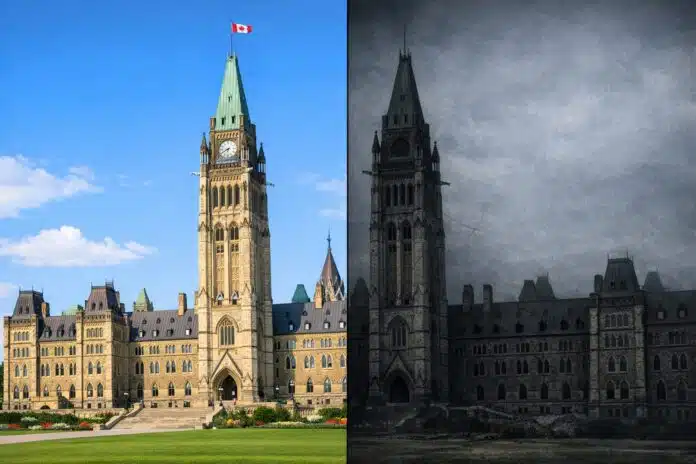
Canada’s Democracy: The System Isn’t Sick. It’s a Crime Scene.
And the people running it are the ones who got away with it.
Part 1 of 5: The System Isn’t Sick. It’s a Crime Scene | [Pillar Page] New? Start here |
≈ 7 min read
(Part 2 coming soon)
This is Part 1 of a 5-part series: When Democracy Fails — Rethinking Canada’s Future.
We’re done pretending. No more “leaders,” no more headlines, no more pearl-clutching about civility. This series strips the corpse of Canadian democracy down to its bones. Using Andrew Coyne’s The Crisis of Canadian Democracy as a starting point—not an endpoint—we follow one argument to its brutal conclusion: Canada’s political system isn’t struggling. It’s dead. And it’s been walking around for years, wearing its old skin, fooling people who need to believe.
By the end of this series, we won’t be asking how to fix this system.
We’ll be asking what kind of fire it takes to burn it down and build something real.
The Lie You’ve Been Fed
You’ve heard the bedtime story:
Canada. Stable. Responsible. Mature. One of the best democracies in the world.
Say it enough times, and even the exploited start nodding along.
It’s not a fact.
It’s a leash.
And most people don’t look too closely because looking closely means admitting you’ve been played.
Andrew Coyne didn’t write a warning.
He wrote an autopsy.
And what he found isn’t a system under stress.
It’s a system that stopped working the moment people stopped paying attention.
It’s a system that no longer functions the way people think it does.
Canadians are told a simple story. We live in one of the best democracies in the world. But as I wrote in The Myth, the story we tell ourselves is often the very thing keeping us from seeing reality.”
The Shape of Democracy. None of the Substance.
We still vote. We still have a Parliament. We still get press conferences and angry Question Period clips for social media.
From the outside? A perfect museum piece.
Inside?
Parliament doesn’t check power.
MPs don’t act independently.
Debate is theatre. Votes are choreography.
Decisions aren’t made in the chamber.
They’re made in back rooms, by party bosses, by corporate donors, by people who never have to win your vote.
And then wrapped in a flag and sold to you as “democracy.”
You Already Know. You Just Swallow It.
Let’s stop dancing around it.
You’ve watched MPs stand up and read scripts like hostages.
You’ve seen bills rammed through with less scrutiny than a fast-food order.
You’ve watched party leaders tighten their grip while everyone else salutes.
None of this is hidden.
It’s normalized.
That’s how power survives in Canada. Not through tanks.
Through your quiet exhaustion.
Through quiet acceptance.
Parliament Doesn’t Restrain Power. It Costumes It.
In theory: Parliament holds the government accountable.
In reality: Parliament is a stage.
Debate changes nothing. Committees take orders. Votes are known before anyone speaks.
Why?
Because MPs don’t vote for their constituents.
They vote for their career.
And their career depends on never crossing the leader.
That’s not representation.
That’s a loyalty test with a pension.
Representation Without Power Is Just Aesthetic
You’re told your MP represents you.
Represents you how?
They don’t control legislation.
They don’t shape policy.
They don’t vote freely.
So what exactly are they representing?
Your zip code? Your hopes while their hands are tied?
Democracy isn’t a photo op.
Take away an MP’s power to act, and you’ve got a prop.
And props don’t hold the powerful accountable.
Accountability Is a Joke We Tell Ourselves
Scandal. Report. Questions. Delay. Deflection. New scandal.
That’s the cycle.
Nobody falls. Nobody goes to jail. Nobody even loses sleep.
The system doesn’t punish abuse.
It processes it.
Then moves on, because the people enforcing accountability are inside the same structure that benefits from avoiding it.
That’s not a glitch.
That’s the design.
Not a Rough Patch. A Ruling Class.
Three parties. Two colours. One set of outcomes.
Different faces. Same structure. Same donor class. Same silence.
When the problem repeats no matter who’s in charge, it’s not leadership.
It’s the system working exactly as intended:
To concentrate power, control outcomes, and make sure nothing fundamental ever changes.
I spoke to this here: Who Owns Canada? Corporate Power and the Illusion of Democracy
“At Least We’re Not America” Is Not a Defence
Canadians love comparing themselves to disaster zones.
At least we’re not them.
At least we don’t have that chaos.
That’s not a standard. That’s a cope.
A system doesn’t need tanks on the lawn to fail.
It just needs to keep promising what it no longer delivers.
And we’ve been cashing that cheque for decades.
Coyne Got Close. Then He Stopped.
Coyne names the rot. He shows you the concentration of power, the collapse of accountability, the theatre of Parliament.
But he won’t say what comes next.
Because saying it means crossing a line polite liberals never cross:
If the system cannot correct itself…
If the people in power benefit from keeping it broken…
Then reform is a lie. And replacement is the only honest word.
So Let’s Be Honest
This isn’t a system that needs a tune-up.
It’s a system that no longer works as advertised.
It’s a system that needs to be dismantled.
And systems like that don’t fix themselves.
They persist. They adapt. They absorb criticism.
Until people stop accepting the terms of their own subordination.
Most Political Talk Assumes the System Works. That’s the Trap.
What if the system is doing exactly what it was built to do?
Concentrate wealth. Channel dissent into dead ends. Protect power from democracy.
If that’s true, then “how do we fix it?” is a distraction.
You don’t fix a machine that’s working as designed.
You smash it.
That’s the signal people ignore. When a problem repeats regardless of who is in charge, it’s not a leadership issue. It’s a system issue—what I called in Class Conflict vs Class War ‘the system working exactly as it was designed.’
That’s the Line We’re Crossing
In Canada, you can criticize leaders. You can criticize policies.
But you’re not supposed to question the structure itself.
That’s where this series lives now.
Because once you name the structure as the enemy, the conversation stops being about policy.
And starts being about power.
And who gets to hold it.
Once You See It, You Can’t Unsee It
The problem isn’t that the system is failing.
The problem is that it has already failed—
and we’re still out here pretending we just need a better manager.
Where This Series Goes Next
This is the starting point.
Not a conclusion. Not a solution.
A recognition.
If we’re going to talk honestly about democracy in Canada, we have to start here:
The system isn’t strained.
It isn’t outdated.
It isn’t temporarily off track.
It’s broken.
And in the next part, we get specific about how that happened—
how power didn’t just drift to the centre…
but was pulled there, concentrated, and locked in place.
_______________
Next: The Prime Ministerial Monarchy: How Power Became Centralized
[« Previous](none) | Part 1 | [Part 2 »](link-to-part-2-when-live) | [Pillar Page]
📌 Sources & Further Reading
The Crisis of Canadian Democracy – Andrew Coyne (review & analysis)
A sweeping critique of Canada’s political system, arguing that its institutions are in “advanced disrepair” and may no longer qualify as a functioning democracy. Highlights the erosion of parliamentary accountability, disempowered MPs, and the growing gap between democratic form and substance.
👉 https://www.policymagazine.ca/andrew-coynes-cri-de-coeur-for-canadian-democracy/ [policymagazine.ca]
Party Discipline in Canadian Politics – Canadian Journal of Political Science
Shows that strict party discipline remains a central feature of Canadian politics despite decades of criticism and reform attempts. Demonstrates how MPs are structurally constrained from acting independently, reinforcing centralized control within party leadership.
👉 https://www.cambridge.org/core/journals/canadian-journal-of-political-science-revue-canadienne-de-science-politique/article/party-unity-and-discipline-in-canadian-politics/E8ED86402328FC0069E6374D49A73CFB [cambridge.org]
Canada’s Democratic Deficit – Policy Magazine (review of Donald Savoie)
Argues that Canadian democracy is “deeply unhealthy,” pointing to long-term centralization of power in the prime minister’s office and a decline in cabinet and parliamentary influence. Highlights how institutional structures make meaningful reform difficult to achieve.
👉 https://www.policymagazine.ca/canadas-democratic-deficit/ [policymagazine.ca]
Canada’s Lobbying Industry: Unequal Influence and Corporate Power – Canadian Journal of Political Science
Empirical research showing the dominance of business interests in Canadian lobbying and a “high level of concentration” of influence. Concludes that while access to government has increased, political voice remains unequal—raising concerns about whose interests the system actually serves.
👉 https://www.cambridge.org/core/journals/canadian-journal-of-political-science-revue-canadienne-de-science-politique/article/canadas-lobbying-industry-business-and-public-interest-advocacy-from-harper-to-trudeau/215E945A290B55B7C57A3C5FCAE3DDF1
_______________
❖