


Class Conflict vs Class War in Canada
We are not in a class war. Not yet. But don’t mistake the quiet for peace.
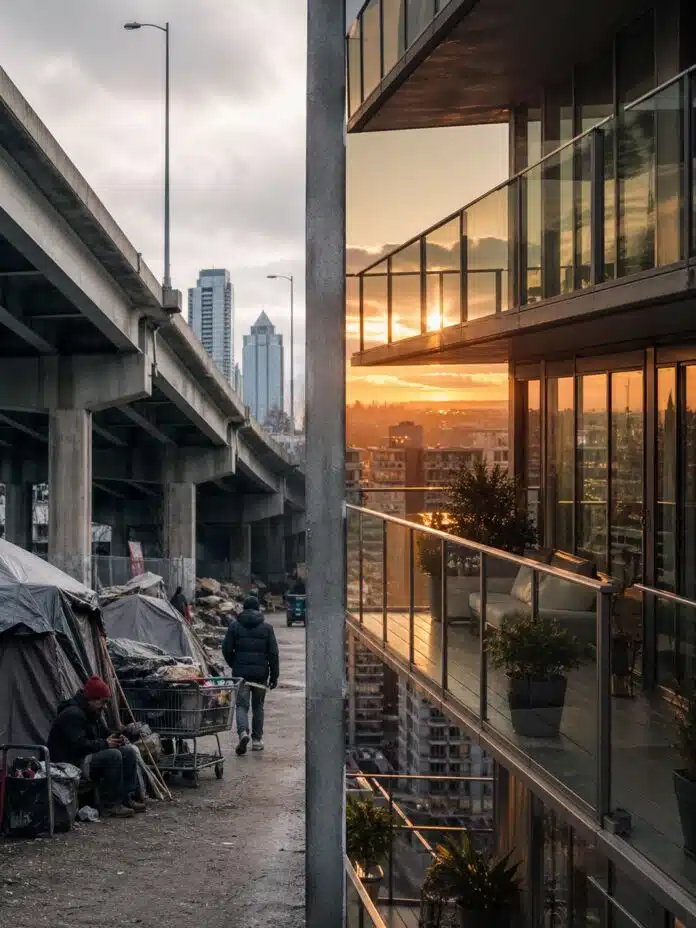
Walk through any city in this country. Look at the tents along the highway off-ramps. Look at the working poor lining up outside food banks before their night shifts start. Look at the young couples who have given up on owning a four-bedroom detached home—they’d just like to afford a one-bedroom apartment without a roommate.
Then drive twenty minutes to the neighbourhoods we can’t afford to drive through. Look at the houses that sit empty for eleven months of the year. Look at the investment properties multiplying like rabbits while families double up in basements.
That silence you hear? That’s not peace. That’s the quiet before the break.
We have been told for years that class is an outdated concept. That we’re all middle class now. That the real divisions are regional, cultural, generational.
But here is what the numbers actually say: in the third quarter of 2025, the gap between the top 40 per cent of earners and the bottom 40 per cent widened again. The bottom 20 per cent saw their disposable income drop while the top 20 per cent saw theirs rise by over four per cent. The wealthiest one-fifth of households now hold 65.5 per cent of everything. The bottom 40 per cent hold just over three per cent.
Let that sink in. Three per cent.
This is not a bug in the system. This is the system working exactly as it was designed.
How We Got Here
Ha-Joon Chang, one of the few economists willing to say what everyone else is thinking, put it plainly: “Making rich people richer doesn’t make the rest of us richer”. This sounds obvious when you say it out loud. And yet we have spent forty years building policy on the exact opposite assumption.
Trickle-down economics was never a serious theory. It was a sales pitch. And we bought it.
Chang also points out something that should embarrass every business school graduate: “Companies should not be run in the interest of their owners”. The shareholder-first model that has gutted wages, outsourced jobs, and stripped pensions? It was a choice. Not an inevitability. Real human beings made that choice, and real human beings can unmake it.
“I mapped the whole architecture of who actually sits at the top of this country — the banks, the telecoms, the grocery giants — in a piece called Who Owns Canada? Spoiler: it’s not you.”
But they won’t. Not on their own. Because the people making the choice are the ones collecting the cheques.
The New Robber Barons
Loretta Napoleoni has a name for this moment: Techno-Capitalism. She describes it as “the genesis of a new paradigm” where those who control the technology are the absolute masters. The tech titans didn’t become billionaires by accident. They became billionaires because the system was rigged to let them.
Napoleoni warns that digitalization is undermining the state itself. When billionaires can launch rockets into space for fun while their workers rely on food stamps, the social contract is already dead. We’re just arguing about the funeral arrangements.
She says we are “sleepwalking towards dystopia”. But sleepwalking implies we don’t know what’s happening. We know. We just feel powerless to stop it.

What Class Actually Means
Vivek Chibber cuts through the fog. In his work on the ABCs of Capitalism, he states what should be obvious: “There is a small group of people who own almost everything, while the vast majority of people own almost nothing”.
That’s it. That’s the whole system in two sentences.
Class is not about your salary or your education or the car you drive. Class is about whether you have to show up to work tomorrow because if you don’t, you don’t eat. Class is about whether your income comes from your labour or from what your labour produces for someone else.
Hadas Thier puts it even more sharply: “Capitalism is not designed to meet human need; it is designed to generate profit”. This means that every crisis—housing, health care, climate—is not an accident. It is the predictable outcome of a system that treats human beings as costs to be minimized and shareholders as value to be maximized.
Thier also reminds us that “the bulk of day-to-day responsibilities for the reproduction of labour at home fall on wives, daughters, mothers, and sisters. This unpaid labour does not directly create surplus value, yet it is critical to workers’ abilities to produce surplus”. The system doesn’t just exploit us at work. It exploits us at home too. And we’re expected to smile through all of it.
The Divide-and-Conquer Playbook
The wealthy have one advantage that outweighs all their money: they understand that a divided working class is a cheap working class.
Thier quotes Frederick Douglass: “Pitting Black workers against white workers against immigrant workers has been a particularly potent, tried-and-true tactic of employers to drive down all wages”. Divide and conquer. It’s the oldest strategy in the book, and it works every time.
You want to know why your wages have been flat for a decade while your boss bought a second cottage? Because someone convinced you that the immigrant family down the street is your enemy. Because someone told you that the public sector worker with a pension is the problem. Because someone pointed at the person on social assistance and said, “That’s where your taxes are going.”
Meanwhile, the people actually taking your money are untouchable.
“And the political system? Don’t get me started. I broke down Andrew Coyne’s argument about how Parliament is just going through the motions — and why calling ourselves a democracy at this point feels like a joke. Read that here.”
The Housing Fault Line
There is no single issue that better explains Canada’s slide toward class war than housing.
If you bought a house in Toronto or Vancouver before 2010, you are sitting on wealth you did not earn through labour. That’s fine. Good for you. But don’t pretend that your windfall was merit-based. You got lucky with timing and interest rates.
If you are under forty today, you face a choice: rent forever, move hours away from your family and job, or rely on inheritance from the generation that pulled the ladder up behind them.
This is not a market. This is a transfer of wealth from the young to the old, from the working class to the investor class. And it is deliberate.

The government will announce new housing programs. The banks will offer new mortgage products. None of it will address the core problem: housing is treated as an asset class first and a place to live second. As long as that remains true, nothing will change.
“I’ve said it before and I’ll say it again: the housing crisis isn’t bad luck. It’s policy. I laid out exactly how shelter became a speculative weapon in my breakdown of why treating homes like stock tickers was always going to end like this.”
Labour Is Waking Up
Here is where the story gets interesting.
In October 2025, part-time support workers at Ontario’s 24 colleges voted 64 per cent in favour of strike action. Ten thousand workers. Many of them students themselves. Fighting for paid sick days and fair wages and basic dignity.
This is happening everywhere. Not in a coordinated way—not yet. But the strikes are increasing. The militancy is returning. Workers who spent decades being told that unions were useless are starting to realize that the alternative is worse.
The question is whether these sparks can start a fire.
Where‘s This Heading?
Let me be clear: we are not in a class war right now.
We are in a class conflict. A slow, grinding, exhausting conflict where one side has all the power and the other side has all the numbers. The rich are winning because they always win when people fight alone.
But conflict can become war. And war changes the rules.
A true class war would mean general strikes. It would mean mass civil disobedience. It would mean people refusing to participate in an economy that has declared them expendable. It would mean the kind of disruption that makes politicians and CEOs very, very nervous.
We are not there yet. But we are closer than we have been in fifty years.
What’s the Danger?
The danger of class war is not that the workers might win. The danger—for those who currently hold power—is that a prolonged conflict would break things that cannot be fixed.
Once trust is gone, you don’t get it back. Once people realize that the rules were never designed to protect them, they stop following the rules. And when enough people stop following the rules, you don’t have a society anymore. You have a survival zone.
The wealthy think they can ride this out. They think their gated communities and private security and offshore accounts will protect them. They are wrong.
You cannot wall off desperation. You cannot airlift groceries to a compound when the roads are blocked. And you cannot reason with someone who has nothing left to lose.
“So what the hell do we actually do? I wrote a whole series on that — starting with why the first step isn’t a protest or a petition. It’s a conversation with the person next to you. Here’s where that conversation begins.”
The Call to Action (Don’t Roll Your Eyes)
I hate performative calls to action as much as you do. I’m not going to tell you to vote harder or share more infographics.
Here is what I will tell you: stop fighting the wrong enemies.
The person working two jobs to afford a basement apartment is not your enemy. The family who just arrived from another country and doesn’t know the language yet is not your enemy. The union member with a defined-benefit pension is not your enemy.
Your enemy is the person who owns the building you rent in. Your enemy is the CEO who took a bonus while freezing wages. Your enemy is the investment fund that bought a thousand single-family homes and turned them into rental properties.
Stop looking sideways. Start looking up.
The Last Word
Thier asks the question that should hang over every conversation about the economy: “Is this rotten system the best we can do?”
You already know the answer.
Capitalism is not failing. It is succeeding at what it was built to do: concentrate wealth, exploit labour, and privatize profit while socializing loss. The only question left is whether we will continue to accept the terms.
Class war is not inevitable. But neither is peace. Peace requires a settlement that both sides can live with. And right now, one side is taking everything and leaving the other side with the scraps.
That doesn’t end well.
It never has.
_______________
Sources & Further Reading
Statistics Canada wealth gap data – Official data confirming the widening wealth gap in late 2025. You need to see the actual numbers. The gap is worse than you think. [Citation:5]
URL: https://www150.statcan.gc.ca/n1/daily-quotidien/260413/dq260413a-eng.htm
Ha-Joon Chang on capitalism – 23 Things They Don’t Tell You About Capitalism Cambridge economist‘s breakdown of 23 capitalist myths. Chang doesn’t waste your time with academic hedging. He just tells you how the machine actually works.
URL: https://books.google.co.id/books?id=2v6ny40_R7MC
Loretta Napoleoni‘s Techno-Capitalism – Essential reading on tech billionaires and the end of the social contract. Napoleoni saw this coming before most people knew what a gig economy was.
URL: https://books.google.com.hk/books?id=GZjLEAAAQBAJ
Vivek Chibber’s ABCs of Capitalism – A straightforward Marxist primer without the jargon. Chibber explains why you own nothing and have to wake up for work tomorrow. Short. Brutal. Correct.
URL: https://archive.org/details/abcs-of-capitalism
_______________
❖