

📍 You are reading Part 2 of 5: The Prime Ministerial Monarchy: How Power Got Stolen in Plain Sight
Part of the series: “When Democracy Fails — Rethinking Canada’s Future”
“Each part builds on the last. Skipping ahead will cost you the argument.”
Navigation:
[« Part 1] | [Part 2] | [Part 3 »] [Part 4] | [Part 5] [Pillar Page]
Reading time: approx. 7 minutes
Part 2 -The Prime Ministerial Monarchy: How Power Got Stolen in Plain Sight
Series: When Democracy Fails — Rethinking Canada’s Future
In Part 1, we called the system a crime scene.
Now we name the weapon.
We’re told Canada is governed by Parliament.
Elected representatives. Open debate. Collective decision-making.
That’s the story.
But in practice, power has been pulled upward and inward—away from Parliament, away from MPs, away from public scrutiny.
And concentrated in one place:
The Prime Minister’s Office.
The Power Didn’t Vanish. It Was Seized.
We’re told Parliament governs.
Elected representatives. Open debate. Collective decisions.
That’s the bedtime story for adults.
The truth is brutal and simple:
Power has been pulled away from Parliament, from MPs, from public view—
and concentrated in the PMO like capital in a monopoly.
This wasn’t an accident of history.
It was a heist, slow enough to look like evolution,
protected by every government, Liberal and Conservative alike.
Because the wealthy don’t care which party holds the crown.
They care that the crown exists.
“Power in Canada doesn’t sit where you think it does. This mirrors the same concentration of power I documented in the economy—just in a different building.”
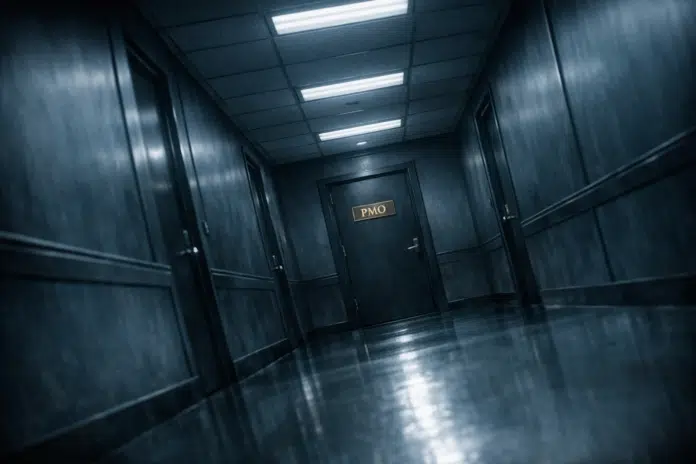
The PMO Isn’t an Office. It’s a Command Bunker.
“Prime Minister’s Office” sounds administrative. Support staff. Schedulers. Flacks.
That’s the camouflage.
Inside, the PMO functions as a political control hub:
- Messaging is manufactured.
- Decisions are pre-chewed.
- Discipline is enforced.
- And nothing of consequence happens outside its permission.
Cabinet doesn’t govern.
Cabinet confirms.
Decisions are shaped before ministers walk in. Dissent is culled before it surfaces.
The growing size of Cabinet isn’t about inclusion—it’s about creating more hostages to the centre.
Loyalty is the only currency that spends.
MPs Aren’t Representatives. They’re Seat-Warmers with Talking Points.
This is where the rot becomes a stench.
MPs are supposed to represent you.
Instead, they operate under one of the strictest party discipline systems in the democratic world.
They don’t vote freely.
They don’t break ranks.
They don’t challenge leadership—unless they’re ready to end their career.
Committee assignments. Promotions. Even their parking spot—all controlled by the party leadership, which is controlled by the PMO.
That’s not representation. That’s a hostage video.
The debate you see on TV?
It’s theatre. Choreographed disagreement.
Ask yourself: when did a debate last change a major decision?
Not delay it. Not reframe it. Change it.
Exactly.
Debate is where decisions are announced, not made.
“By the time they reach the public, they’re no longer part of a conversation. They’re final. This is the same dynamic at play in the housing crisis—decisions made far from those affected, by people who will never feel the consequences.”

The System Rewards Obedience. Punishes Solidarity.
This is the engine:
- Step out of line → buried in committee.
- Vote against the whip → cut off from resources.
- Speak for your riding instead of the leader → primaried or demoted.
The people who rise within this system are the ones who accept it.
The independent ones are filtered out early. And the ones who benefit most? The people who actually own the country.”
That’s not a bug.
That’s the design of a managerial class serving the real owners—the capitalists I named in my class conflict post.
They don’t need to buy every MP.
They just need to control the conditions under which any MP survives.
Leadership Contests? Just Changing the Face on the Throne.
Every few years, Canadians are sold a story:
New leader. New tone. Fresh start.
But the structure doesn’t change.
The PMO doesn’t shrink.
The whip doesn’t soften.
A new face doesn’t redistribute power.
It just resets the clock on hope.
That’s not democracy.
That’s brand management for an oligarchy.
This Is Why Government Feels Like a Distant Wall
People say politicians are out of touch.
They blame “communication.”
No.
The distance is structural.
Decisions are made by a handful of people in a downtown office,
filtered through layers of compliance,
then delivered to you as a fait accompli.
You’re not part of the conversation.
You’re the audience for the press release.
And when nothing changes despite elections?
That’s not bad luck.
That’s the PMO’s entire reason for existing: to ensure continuity of control across governments.
“Responsible Government” Is a Joke We Tell Ourselves
Canada brags about “responsible government”—that the executive is accountable to the legislature.
But if the legislature is controlled by the executive…
If MPs can’t act independently…
If outcomes are fixed before votes happen…
Then accountability is a puppet show.
And the strings run straight to the Prime Minister’s desk.
This Is the Part Liberals Refuse to Say Aloud
Because it cuts too close to the foundation.
If power is this centralized…
If Parliament can’t push back…
If the mechanisms of accountability are hollow…
Then we don’t have a flawed democracy.
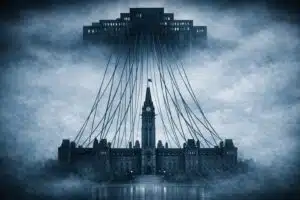
We have an elected monarchy with a parliamentary theme.
And the reason it persists?
Because the people who benefit from it—the corporate class, the donor networks, the extractive industries—need a weak Parliament.
A strong Parliament might ask hard questions about ownership. About wages. About who really controls the country.
The PMO is their insurance policy.
And Yet—It Still Looks Stable
That’s what makes it hard to confront.
There’s no obvious rupture.
No constitutional crisis.
No breakdown of order.
No visible collapse.
Everything continues.
Bills pass.
Governments govern.
Elections happen.
From the outside, it works.
But stability isn’t the same as democracy.
A system can be stable because power is controlled.
Because outcomes are managed.
Because disruption is minimized.
Coyne Charts the Drift. We Need to Name the Theft.
Andrew Coyne shows how power moved:
Parliament → Cabinet → Prime Minister → PMO.
That’s the trajectory.
But he stops short of saying why it can’t reverse.
Because every step of centralization makes it harder to move back.
More control at the top means fewer pathways for resistance below.
And the people at the top choose their successors from among the loyal.
Reform from within is structurally impossible.
Not difficult.
Impossible.
Because the people who would have to vote for reform are the same people whose careers depend on the current system.
So What Are We Actually Looking At?
Not a temporary imbalance.
Not a leadership problem.
Not a communications failure.
We’re looking at a political machine designed to:
- Concentrate power
- Enforce obedience
- Filter out dissent
- And present the whole operation as normal, stable democracy
Until the abnormal starts to feel like the only reality.
This Is Why “Fixing” Parliament Never Works
Every reform assumes power is still distributed.
That MPs want independence.
That accountability can be strengthened from within.
But if power is already locked at the centre,
those reforms get absorbed. Delayed. Neutralized.
You don’t negotiate with a command bunker.
You don’t petition a monarchy into sharing power.
You dismantle it.
Where This Leaves Us (And You)
Part 1: The system is broken.
Part 2: Here’s who broke it and where the power went.
Now you know:
The PMO isn’t a support office. It’s the political enforcement arm of a capitalist class that needs a weak Parliament to keep extracting wealth.
The next question is uglier:
What does “representation” even mean when the people we elect don’t hold power?
That’s Part 3.
And it’s going to hurt.
Next: Parliament in Name Only: Representation Without Power
[« Previous] | Part 2 | [Part 3 »] [Part 4] | [Part 5] [Pillar Page]
_______________
📌 Sources & Further Reading (Part 2)
The Rise of the “PMOocracy” – Policy Options
A detailed breakdown of how power has increasingly centralized in the PMO, reducing the role of Cabinet and Parliament over time.
👉 https://policyoptions.irpp.org/2026/04/fix-ottawa-governance/ [policyopti…s.irpp.org]
(Explicitly discusses “extreme centralization of power in the PMO” and declining role of ministers and Parliament.)
Party Discipline and the Death of Backbench Independence – Library of Parliament Research
Official research confirming that Canada has one of the strictest whip systems in the Westminster world. The numbers don’t lie: 99%+ whipped votes are routine.
👉 https://publications.gc.ca/collections/collection_2019/bdp-lop/eb/YM32-5-2018-26-eng.pdf [publications.gc.ca]
The Prime Minister’s Powerful and Unaccountable Office
Investigative-style analysis on how governing from the centre has weakened Cabinet, sidelined ministers, and shifted real decision-making power into the PMO.
👉 https://policyoptions.irpp.org/2022/05/tellier-mistrust-destroying-public-service/
(Directly documents cabinet bypass and centralization as “presidential government.”)
Democracy Eroded: The Concentration of Executive Power in Canada – Canadian Centre for Policy Alternatives
A left-leaning think tank’s assessment of how Canada performs on executive accountability and democratic structure.
👉 https://policyalternatives.ca/news-research/canadas-crisis-of-democracy/ [policyalte…natives.ca]
_______________
❖