


📍 You are reading Part 5 of 5: Beyond Reform
Part of the series: “When Democracy Fails — Rethinking Canada’s Future”
“Each part builds on the last. Skipping ahead will cost you the argument.”
Navigation:
[« Part 1] | [Part 2] [Part 3] | [« Part 4] | [Part 5] [Pillar Page]
Reading time: approx. 7.5 minutes
This is the conclusion of the series.
Part 5 — Beyond Reform: What Structural Change Actually Means (And Why the Left Must Stop Begging)
Series: When Democracy Fails — Rethinking Canada’s Future
By this point, the pattern is impossible to ignore.
Part 1: The system is a crime scene.
Part 2: The PMO is the weapon.
Part 3: Parliament is the hostage.
Part 4: Reform is the trap.
So the question changes completely.
Not “How do we fix it?”
Not “Which leader do we try next?”
Not “What policy tweak will save us?”
What do you do when the system cannot fix itself—and was never meant to?
This Is Where Most Conversations Stop Dead
Because this is the point where things get uncomfortable.
It’s one thing to criticize a policy.
It’s quite another to say:
The structure itself has to go.
Not adjusted.
Not modernized.
Not “made more accountable.”
Changed.
At the root. In its design. In who holds power and who does not.
That’s the line most people won’t cross.
And the ruling class depends on your hesitation.
“Structural Change” Gets Misunderstood on Purpose
As soon as you say it, the liberal imagination runs to extremes:
Instability. Chaos. Something reckless.
That reaction isn’t accidental.
It’s manufactured.
Every system defends itself by making the alternative sound terrifying.
Feudalism said democracy would bring mob rule.
Capitalism says socialism brings gulags.
The Canadian political class says structural change brings… what, exactly? Uncertainty?
Here’s the reality they don’t want you to touch:
Every system is designed.
And anything designed can be redesigned.
The question isn’t whether change is possible.
It’s who gets to do the designing.
The Problem Isn’t Just Who Holds Power—It’s How Power Works
Up to now, we’ve focused on where power sits.
At the centre. Inside the PMO. Behind party discipline.
But structure goes deeper than location.
It’s about:
- Who can act (the PMO, corporate donors, party leaders)
- Who can block (the same small group)
- Who can decide (almost never you)
Right now, those pathways are narrowed to a funnel.
Power flows upward. Decisions flow downward.
And the rest of us are told to applaud.
That’s not democracy.
That’s a one-way valve from the few to the many—in reverse.
Real Change Means Redistributing Power—Not Just Restraining It
Liberal reformers love talking about “limits.”
Term limits. Spending limits. Oversight committees.
Those matter—but they don’t go far enough.
Because if power stays concentrated, it finds ways around limits.
A weaker leash on the same master is still a leash you don’t hold.
Structural change means shifting where power lives.
Outward. Downward. Into institutions that can’t be captured by a handful of party loyalists.
That means:
- Legislatures that actually check executives
- Representatives who can vote freely without career death
- Citizens who can initiate binding decisions
- Ownership of key industries by the people who work in them and live under them
That’s not “radical.”
That’s democracy without the scare quotes.
Representation Has to Be Rebuilt—Not Tweaked
You cannot fix hollow representation with better websites, more town halls, or “listening sessions.”
If your MP cannot vote independently…
If they cannot challenge leadership…
If their career depends on obedience…
Then representation is cosmetic.
So the question isn’t:
“How do we improve representation?”
It’s:
“What would representation look like if it actually had power?”
That’s a different starting point.
And it leads to places liberal reformers refuse to go:
Free votes. Citizen recall. Proportional representation that breaks the two-party stranglehold.
And ultimately, a Parliament that represents class interests—not donor lists.
Accountability Has to Be Designed—Not Assumed
Right now, accountability in Canada depends on expectation.
On norms. On good behaviour. On the fantasy that powerful people will voluntarily restrain themselves.
We’ve seen how that plays out.
Scandal → report → deflection → nothing.
Structural change means building accountability into the system itself.
So it doesn’t rely on intention.
It operates automatically.
- Binding ethics rules with real consequences
- Independent prosecution of political corruption
- Transparent lobbying with teeth
- And ultimately, economic democracy—because accountability is impossible when your boss is also your landlord, your grocer, and your politician’s biggest donor.
This Isn’t About One Party or One Leader—And That’s the Point
The trap is blaming one government. Waiting for the next. Hoping for better personalities.
But every part of this series has pointed to the same conclusion:
Different parties. Same structure. Same outcomes.
Trudeau. Harper. Poilievre. Lewis. Carney.
Different faces. Same PMO. Same whip. Same donor class.
Replacing leadership without changing the system doesn’t break the wheel.
It just resets the clock on your disappointment.
Related Reading
“Who Owns Canada? Corporate Power and the Illusion of Democracy.”
This Is Where Andrew Coyne Stops—And Where Revolutionary Socialism Begins
Coyne does the hard work of diagnosis.
He shows how power concentrates, how accountability weakens, how Parliament becomes theatre.
But he stops short of this point.
Because once you follow the logic all the way through, you don’t end up at reform.
You don’t end up at better leaders or more transparency.
You end up here:
The system has to be replaced at the structural level.
And that means asking the question Coyne won’t:
Replace it with what?
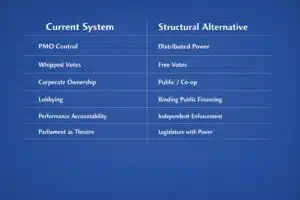
So What Does That Actually Look Like? (Concretely)
Not theory. Not abstraction.
Concrete shifts in who holds power and how.
Here’s where Revolutionary socialism answers the question my previous posts raised:
| Current System | Structural Alternative |
|---|---|
| PMO controls everything | Power distributed across elected, recallable bodies |
| MPs vote as extensions of leaders | Free votes, proportional representation, citizen initiatives |
| Corporate ownership of housing, energy, telecom | Public ownership, worker co-ops, democratic control of essential industries |
| Lobbying as legalized bribery | Binding public financing of elections, lobbyist registry with jail time for violations |
| Accountability as performance | Independent ethics enforcement, citizen-initiated referendums on corruption |
| Parliament as theatre | Legislatures with real power to initiate, amend, and block |
This is not a complete blueprint.
But it’s a direction.
And the direction is clear: Power must move from the few to the many.
That’s not “radical.”
That’s the original promise of democracy—before capitalism bought it and hollowed it out.
The Force for Change Doesn’t Come From Inside
Part 4 made this clear:
Reform from within runs into structural limits.
The people who benefit from the current system will not vote to dismantle it.
So change doesn’t start there.
It starts with recognition.
Public understanding. Clear-eyed analysis.
A willingness to name the system as the enemy.
And then it builds through organization—not petitions, not hashtags, not polite letters to MPs who can’t act anyway.
Unions. Tenants’ associations. Mutual aid. Strike solidarity. Class-wide organizing that refuses to beg.
That’s the force that has always won structural change.
Not legislation.
Power from below.
We’ve Been Taught to Trust the System. That Trust Was Exploited.
That’s part of Canada’s identity.
Stable. Predictable. Responsible.
For a long time, that trust felt justified.
But trust without verification is faith.
And faith is what you rely on when evidence is against you.
The evidence is now overwhelming:
The system produces homelessness, wage stagnation, climate inaction, and democratic theatre—not by accident, but by design.
Trust isn’t a virtue anymore.
It’s a vulnerability.
The Shift That Changes Everything
Moving from:
“The system works, but needs improvement.”
To:
“The system produces these outcomes by design—and therefore must be replaced.”
That shift changes everything.
Because once you see outcomes as structural, not accidental—
You stop expecting different results from the same setup.
You stop voting harder for the same two parties.
You stop asking permission from people who owe their careers to your powerlessness.
You start building alternatives in the spaces capitalism abandoned.

No Easy Ending (Because There Isn’t One)
There’s a temptation to wrap this up with a neat plan.
A 10-point manifesto. A “Socialism for Canadians” checklist.
That would be easier.
But it wouldn’t be honest.
Because structural change isn’t a recipe.
It’s a fight.
A long, grinding, dangerous fight against a system that has every advantage—except numbers.
The ruling class has money, media, and the PMO.
We have each other—and the growing realization that nothing else works.
That’s not nothing.
That’s the only thing that has ever won.
Where This Leaves Us (And You)
This series began with a simple recognition:
The system isn’t sick. It’s a crime scene.
Now you have the full autopsy:
- Part 1: It’s broken by design.
- Part 2: The PMO is the weapon.
- Part 3: Parliament is the hostage.
- Part 4: Reform is the trap.
- Part 5: Only structural change—revolutionary socialism—can break the cycle.
Not because socialism is a magic word.
But because capitalism’s political form (centralized, unaccountable, theatre-based) cannot be separated from capitalism’s economic form (private ownership, extraction, wage slavery).
You cannot fix the PMO while Bay Street still owns the country.
You cannot free Parliament while MPs owe their careers to donors.
You cannot have democracy when the economy is a dictatorship.
Political power follows economic power.
Always has. Always will.
So the question isn’t: “How do we fix Parliament?”
It’s: “Who should own the economy—and how do we take it back?”
End of Series
But not the end of the conversation.
You started with the Pillar Page. You’ve now worked through all five parts — from the PMO’s command bunker to the hollowing out of Parliament, from the trap of reform to the necessity of structural change.
This was the diagnosis.
The question now isn’t theoretical. It’s practical:
Are you ready to stop asking for permission?
Revolutionary socialism isn’t a slogan. It’s the only honest answer to a system that cannot be reformed because it was never built to serve you.
The only question left is what you do with what you’ve just read.
_______________
Navigation:
[« Part 1] | [Part 2] [Part 3] | [« Part 4] | [Part 5] [Pillar Page] End of Series. The only question left is what you do with it.
📌 Sources & Further Reading (Part 5)
From Reform to Replacement: Why Socialists Don’t “Fix” Capitalism – Jacobin
A clear leftist argument that capitalism’s political structures (centralized, unaccountable) are inseparable from its economic ones. Concludes that reformism is a dead end.
👉 https://jacobin.com/2025/12/reform-revolution-history-social-democracy
Collective Capital Formation as a Strategy for Economic Democracy – Rosa Luxemburg Stiftung
A detailed exploration of what structural change actually looks like: worker co-ops, public ownership, participatory planning, and democratized finance. Practical, not utopian.
👉 https://www.rosalux.de/publikation/id/1948
The Limits of Liberal Reform – Jacobin
A left critique of why “accountability” and “transparency” bills fail to challenge concentrated power. Argues that only class-based organizing can force structural change.
👉 https://jacobin.com/2025/09/social-democracy-socialism-transition-reforms
“We Can Be Certain That Capitalism Will End” – Rosa Luxemburg Stiftung
A tactical guide to understanding structural inertia and building power from below. Essential reading for anyone tired of petitions and ready for something that works.
👉 https://www.rosalux.de/en/news/id/39236
_______________
❖